
News
Alake of Egba Land Urges FG to Declare July 13 Wole Soyinka Day

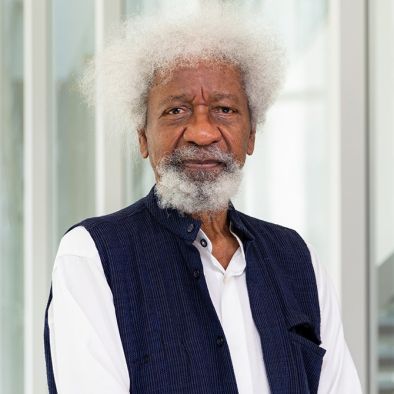
The Alake of Egba Land, Oba Adedotun Gbadebo, has urged President Bola Tinubu to declare July 13 as a national day to honor Nobel Laureate, Prof. Wole Soyinka, in recognition of his immense contributions to humanity and literature both in Nigeria and globally.
Oba Gbadebo also recommended that the Federal Government award Soyinka the Grand Commander of Order of Niger (GCON), the nation’s second highest honor, as the literary icon approaches his 90th birthday.
The traditional ruler announced that Egba Land has already decided to celebrate July 13, Soyinka’s birthday, as Wole Soyinka Day annually. This initiative aims to promote Soyinka’s ideals and his outstanding scholarship to future generations.
As the first African Nobel Prize winner in Literature and an acclaimed international playwright, Soyinka’s work and activism have garnered global recognition. Oba Gbadebo made this appeal during a press conference in Abeokuta, Ogun State, outlining the events planned for Soyinka’s 90th birthday celebration.
The monarch highlighted Soyinka’s status as a global icon, a living legend, and a respected elder statesman with deep roots in Ake, Abeokuta. The theme for the 90th birthday celebration is “Defiance and Creativity: A Celebration of Soyinka’s Artistic Ingenuity and Impact on Nigeria, Africa, and The Entire World.”
Oba Gbadebo stated, “It is fitting for the Federal Government to adopt July 13 as a national day to celebrate Prof. Wole Soyinka, considering his contributions to literature and humanity on a global scale. New Orleans in the United States of America has already designated a day in his honor, so it is only right that we do the same for our own distinguished figure.”
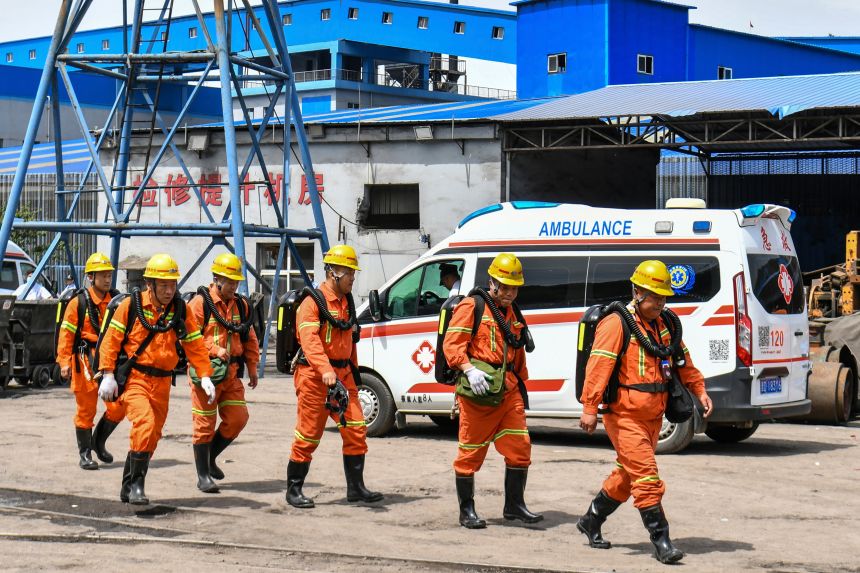
At least 90 people have died following a massive gas explosion at a coal mine in northern China, according to state media reports.
The blast occurred on Friday evening at the Liushenyu Coal Mine in Shanxi province and is being described as China’s deadliest mining disaster since 2009.
Officials said 247 workers were on duty when the explosion happened at about 19:29 local time. More than 100 miners were reportedly rescued, while hundreds of emergency personnel were deployed to the site.
Xi Jinping called for every possible effort to be made to treat the injured and continue the search for survivors.
China’s State Council later announced that a “rigorous” investigation would be launched and warned that anyone found responsible for the disaster would face severe punishment.
Authorities said 27 people remain in hospital, including one in critical condition. Most survivors are believed to have suffered from inhaling toxic gas, although officials have not confirmed the exact substance involved.
One injured miner, Wang Yong, told state media he saw smoke suddenly spread through the tunnel moments after the explosion.
“I smelled sulphur, the same smell you get from blasting,” he said. “I shouted at people to run. As we were running I could see people collapsing from the fumes. Then I blacked out too.”
He added that he regained consciousness about an hour later and escaped with another worker.
State media reported that several members of the mine’s management team have been detained as investigations continue into the cause of the explosion.
Officials said dangerous levels of carbon monoxide — a highly toxic and odourless gas — had been detected inside the mine after the incident.
China’s Ministry of Emergency Management has dispatched 345 rescuers from six specialist teams to assist with recovery operations.
Rescue efforts have reportedly been complicated by flooding near the blast area, making some sections inaccessible. Authorities also said mine blueprints provided to rescue teams did not accurately reflect the underground conditions, creating further challenges during the operation.
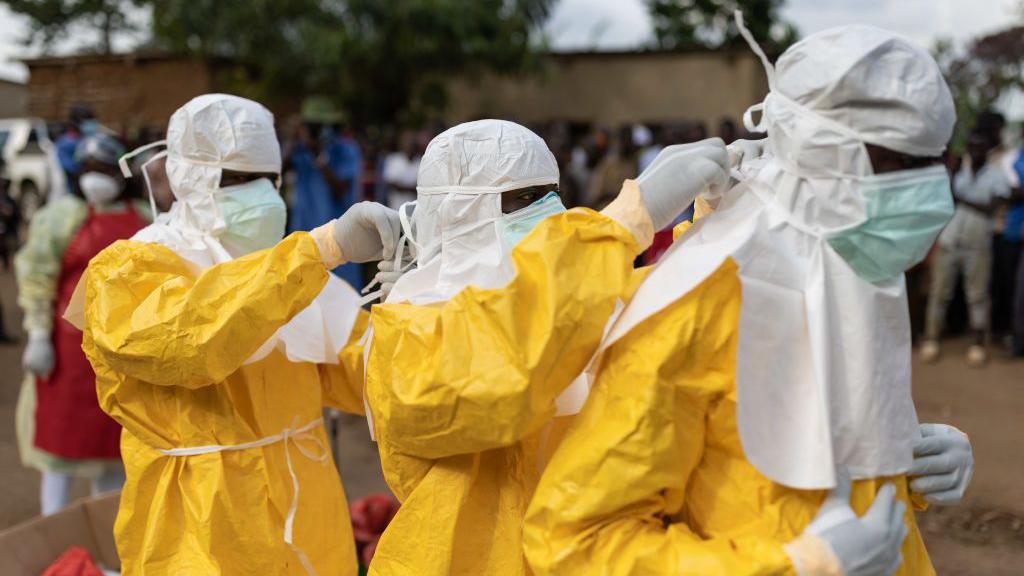
The Democratic Republic of the Congo has cancelled its planned pre-World Cup training camp in Kinshasa because of the worsening Ebola outbreak in the eastern part of the country.
Preparations for the tournament will instead take place in Belgium as authorities respond to an outbreak that has reportedly killed more than 130 people.
The World Health Organization has declared the outbreak a “public health emergency of international concern”, although it has stopped short of classifying it as a pandemic.
Jerry Kalemo, spokesperson for the national football team, said planned warm-up matches in Europe would still go ahead as the team prepares for its first FIFA World Cup appearance since 1974.
DR Congo are scheduled to face Denmark in Belgium on 3 June and Chile in Spain on 9 June before opening their World Cup campaign against Portugal in Houston on 17 June.
Team officials said the decision to cancel the Kinshasa camp was linked to travel restrictions introduced by the United States in response to the Ebola outbreak.
Under the restrictions, non-Americans who have recently visited DR Congo, Uganda or South Sudan within the previous 21 days are barred from entering the US.
Because all DR Congo players and head coach Sébastien Desabre are based outside the country, they are not expected to be affected by the rules now that the training camp has been relocated.
Some support staff based in DR Congo reportedly left the country on Wednesday before the 21-day travel restriction window came into effect.
The planned Kinshasa camp had been expected to attract supporters and senior officials, including President Felix Tshisekedi.
Although Kinshasa lies around 1,800km from Ituri province — the centre of the outbreak — no Ebola cases have yet been reported in the capital.
The WHO said on Wednesday that 139 people were believed to have died from around 600 suspected cases, while Congolese health minister Samuel Roger Kamba later stated on national broadcaster RTNC TV that authorities had recorded 159 deaths.
The United States has filed criminal charges against former Cuban leader Raúl Castro over the 1996 shooting down of two civilian aircraft belonging to the Cuban-American organisation Brothers to the Rescue.
The charges, announced on Wednesday, accuse Castro and five others of conspiracy to kill US nationals, destruction of aircraft and multiple counts of murder linked to the deaths of four men, including three Americans.
The victims were identified as Armando Alejandre Jr, Carlos Alberto Costa, Mario Manuel de la Peña and Pablo Morales.
At the time of the incident, Castro was head of Cuba’s armed forces. The aircraft were shot down over waters between Cuba and Florida, triggering widespread international condemnation.
Speaking in Miami at Freedom Tower, Acting Attorney General Todd Blanche said the case reflected the US government’s determination to pursue accountability decades after the incident.
“The United States, and President Trump, does not, and will not, forget its citizens,” Blanche said.
Some of the charges carry the possibility of life imprisonment, while the murder counts could potentially result in either life sentences or the death penalty if prosecuted successfully in a US court.
The move comes as Washington increases pressure on Cuba’s communist government amid longstanding tensions over political freedoms and economic reforms.
Cuban President Miguel Díaz-Canel condemned the charges, calling them “a political manoeuvre, devoid of any legal foundation”.
Analysts say the charges form part of a broader US strategy aimed at intensifying pressure on Havana’s leadership.
William LeoGrande, a Latin America expert at American University, said the approach appeared designed to push Cuba toward concessions through mounting economic and political strain.
The US has maintained sanctions against Cuba and recently tightened restrictions affecting oil supplies to the island, contributing to ongoing blackouts and shortages of food and fuel.
Earlier on Wednesday, US Secretary of State Marco Rubio issued a message marking Cuba’s independence day, saying President Trump was offering “a new path between the US and a new Cuba”.
Rubio also accused the military-linked conglomerate GAESA of being largely responsible for Cuba’s worsening economic difficulties, including power outages and shortages.
GAESA controls major sectors of the Cuban economy, including ports, fuel distribution and luxury hotels.
In response, Díaz-Canel accused the United States of spreading misinformation and imposing collective punishment on the Cuban population.


Bruno Fernandes Named Premier League Player of the Season

At Least 90 Killed in China Coal Mine Explosion

Mohamed Salah Set to Captain Egypt at World Cup


-

 Entertainment1 week ago
Madonna, Shakira and BTS to Headline Historic World Cup Final Half-Time Show
-
 News1 week ago
Rescue Diver Dies During Search for Italian Divers Missing in Maldives Cave Tragedy
-
 News6 days ago
Train Driver in Deadly Bangkok Crash Tested Positive for Drugs
-

 Sports1 week ago
Celtic F.C. Stun Heart of Midlothian F.C. to Seal Dramatic Title Win
-
News6 days ago
Bodies of Missing Italian Divers Found in Maldives
-
 Politics1 week ago
Labour MP Josh Simons to Resign
-
 News6 days ago
Six Americans Exposed in DR Congo Ebola Outbreak
-
News4 days ago
WHO Warns Ebola Cases in DR Congo Likely to Rise Further