
News
Biden Ends Re-Election Bid, Calls It ‘Greatest Honour’ to Serve as President

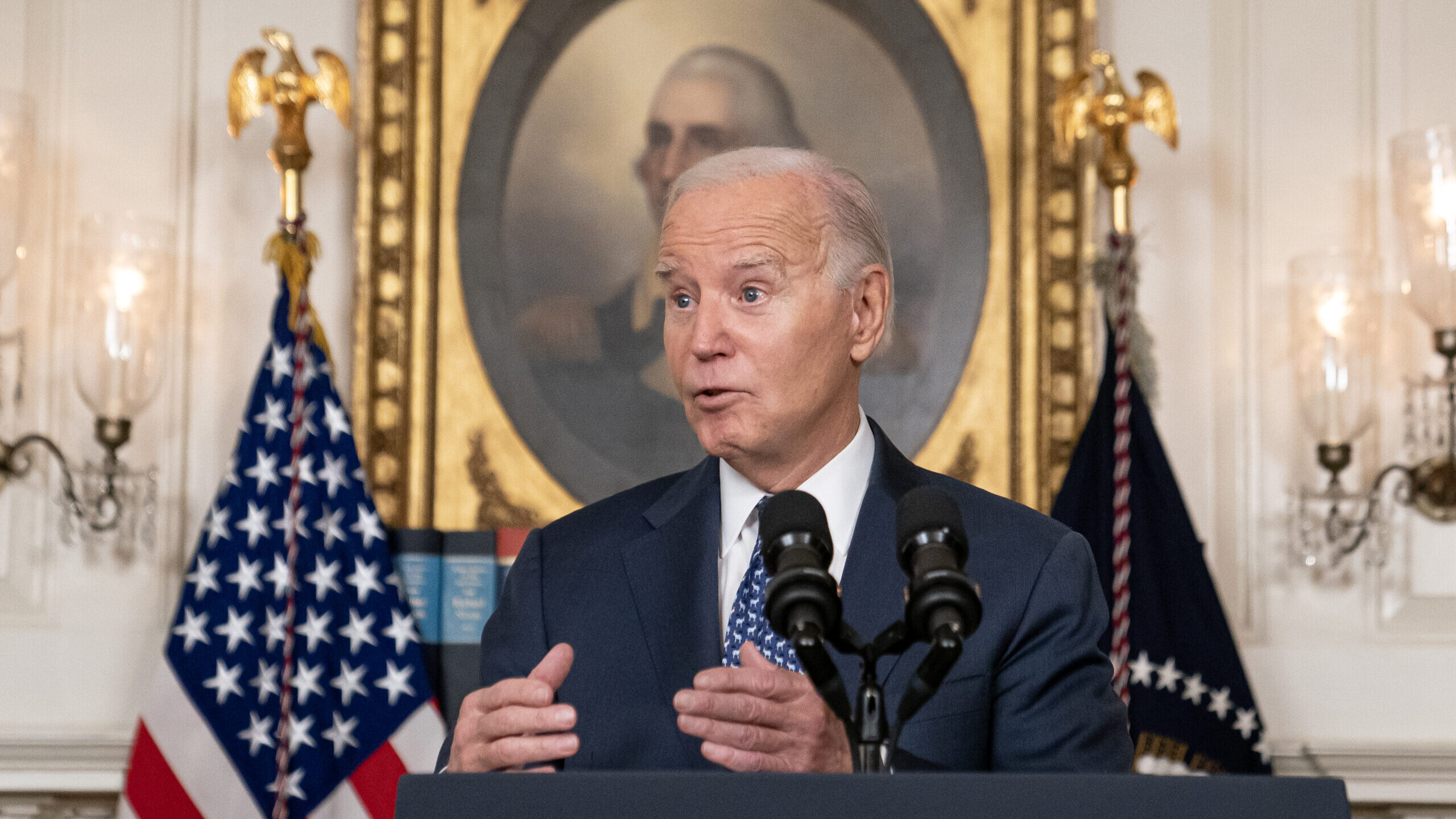
In a surprising move, US President Joe Biden has announced he will not seek re-election, stating it is “in the best interest of my party and the country.” This decision comes four months before the upcoming presidential election, dramatically altering the race for the White House.
Biden’s decision follows weeks of mounting pressure from fellow Democrats, especially after a lackluster debate performance against Republican candidate Donald Trump in late June. The President faced criticism during the debate for appearing incoherent and speaking with a weak voice, which his party attributed to a cold.
In his Sunday evening announcement, Biden endorsed Vice President Kamala Harris for the presidency. He praised Harris, saying his choice to select her as his running mate in 2020 was “the best decision I’ve made.” Harris responded by pledging to “unite the Democratic Party and our nation to defeat Donald Trump.”
Biden shared his resignation news in a letter on social media, calling it the greatest honour of his life to serve as president. He emphasized his commitment to focus on fulfilling his duties for the remainder of his term. “And while it has been my intention to seek re-election, I believe it is in the best interest of my party and the country for me to stand down,” he wrote.
The President thanked Vice President Harris, calling her an “extraordinary partner,” and expressed gratitude to the American people for their faith and trust. He reaffirmed his belief in America’s potential, saying, “There is nothing America can’t do – when we do it together.”
Biden plans to address the nation on this matter next week. Despite his recent Covid-19 diagnosis, he had expressed eagerness to return to the campaign trail. Biden had previously declared only a serious health condition would make him withdraw from the race, highlighting the significance of his recent decision.
Republican nominee Donald Trump reacted to Biden’s announcement on his Truth Social platform, claiming Biden was “not fit to run for president.”



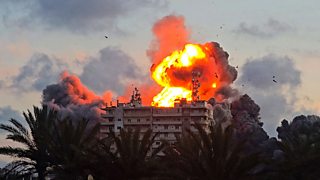
Israel has carried out a strike on the Lebanese capital, Beirut, marking only the second attack on the city since a ceasefire came into effect last month.
The Israel Defense Forces (IDF) said the operation, launched at about 14:00 local time (11:00 GMT), was conducted in a “targeted manner”, though officials did not immediately release further details about the intended target.
Israeli media, citing unnamed security sources, reported that the strike was aimed at Ali al-Husni, described as the head of the missile force in the Imam Hossein Division, an Iranian-backed militia aligned with Hezbollah.
The strike hit Dahieh, the densely populated southern suburb of Beirut regarded as Hezbollah’s main stronghold in the capital. Thick smoke rose above residential buildings following the explosion, while residents were heard calling out for relatives and neighbours as emergency crews rushed into the area.
The latest escalation comes despite efforts to maintain a fragile ceasefire between Israel and Hezbollah. Both sides have repeatedly accused each other of violating the agreement through cross-border attacks and military operations.
According to reports, Israel had previously avoided striking Beirut after a request from Donald Trump. However, the latest attack followed waves of Israeli airstrikes targeting Hezbollah infrastructure in southern Lebanon.
The renewed military activity also comes after Israeli Prime Minister Benjamin Netanyahu announced an expansion of ground operations following Hezbollah drone attacks on Israeli troops stationed in southern Lebanon and civilians in northern Israel.
On Wednesday, the IDF warned Lebanese residents to move north of the Zahrani River, approximately 40km from the Israeli border, saying Israeli forces would operate “with extreme force” in affected areas.
Lebanon’s health ministry said at least 11 people were killed in two separate Israeli strikes that targeted the city of Tyre and nearby eastern areas early on Thursday.
Videos shared on social media from Tyre showed streets illuminated by flames, smoke covering roads, and several vehicles damaged or burning. In daylight footage, a large fireball could be seen erupting near high-rise residential buildings, sending a mushroom-shaped plume of smoke into the sky as debris scattered through nearby streets.
The latest developments underline the continuing instability along the Israel-Lebanon border, with growing concerns that repeated exchanges of fire could trigger a wider regional confrontation involving Iran-backed armed groups and Israeli forces.
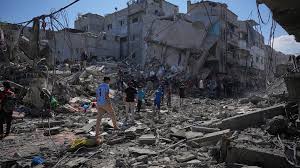
The head of the military wing of Hamas, Mohammed Odeh, has been killed in an Israeli strike in Gaza City, only days after the death of the group’s previous military commander in a separate attack.
Local medics and witnesses said the strike, which took place on Tuesday, also left dozens of people injured after a residential building in one of Gaza City’s busiest market districts was hit.
The Israeli military and the Shin Bet security agency said the operation targeted buildings allegedly being used as a hideout by Odeh. According to a joint statement, Israeli forces had tracked his movements and those of his associates over several months before carrying out the strike.
On Wednesday, Hamas confirmed that Odeh had died in the attack along with his wife and two of his children.
Although a ceasefire between Israel and Hamas was agreed in October, incidents of violence have continued to occur across the Gaza Strip on an almost daily basis, highlighting ongoing tensions despite international hopes for a more stable security situation.
Tuesday’s strike hit the top three floors of the al-Kayali building in central Gaza City, where crowds had gathered for shopping activities ahead of the Muslim holiday of Eid al-Adha.
Emergency and rescue teams quickly moved to the scene to assist victims and search through the damaged structure. However, witnesses said rescue operations were slowed by severe destruction to the building and heavy congestion in the surrounding streets.
In a statement, the Israel Defense Forces and Shin Bet said: “As part of the joint operation by the IDF and Shin Bet to eliminate the terrorist Mohammed Odeh, several buildings in the heart of Gaza City that served as a hideout for him were attacked, after months of intelligence surveillance in order to track his movements and the movements of his assistants in the organisation.”
The statement added that Israeli forces also struck “a nearby apartment belonging to a Hamas terrorist who raided on October 7 and was part of Odeh’s circle of assistants,” referring to the Hamas-led attack on southern Israel that sparked the war in Gaza.
The latest developments come as international mediators and humanitarian organisations continue to push for renewed efforts aimed at reducing violence and improving conditions for civilians affected by the prolonged conflict.

Two schoolchildren and two adults have died after a train collided with a school minibus in the Belgian town of Buggenhout.
The crash happened shortly after 08:00 local time as the minibus was transporting pupils to a special education school, according to Belgian federal police.
Police spokeswoman An Berger said the vehicle was carrying seven children, along with a driver and a chaperone, when the collision occurred at a level crossing.
Berger explained that the driver had been travelling along a road parallel to the railway line before turning left onto the crossing while the safety barriers were already lowered.
A train passing through Buggenhout then struck the minibus.
Belgian mobility minister Jean-Luc Crucke confirmed reports that the crossing barriers had been down at the time of the accident.
“My first thoughts are with the victims,” he said following the tragedy.
Images from the scene showed the heavily damaged minibus lying on its side near the railway tracks in Buggenhout, a town near Aalst northwest of Brussels.
Authorities said nobody aboard the train was injured, although one passenger was treated for shock.
Zuhal Demir described the incident as “heartbreaking news” and said her thoughts were with the victims, their families and everyone affected.
Ursula von der Leyen also reacted to the crash, saying: “Today, Europe grieves with Belgium.”


Sinner Shock Exit Blows French Open Wide Open After Five-Set Defeat

Israeli Strike Hits Beirut as Tensions Escalate Despite Ceasefire

Manchester United Move Closer to Signing Ederson in £38m Midfield Deal


-

 News1 week ago
Democratic Republic of the Congo Cancels World Cup Camp Over Ebola Outbreak
-
News1 week ago
WHO Warns Ebola Cases in DR Congo Likely to Rise Further
-

 News5 days ago
Marco Rubio Says US-Iran Deal Could Come Monday
-
 Sports1 week ago
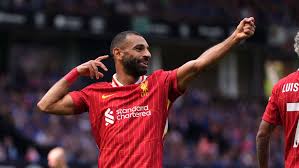
Mohamed Salah Set to Captain Egypt at World Cup
-

 Entertainment4 days ago
BTS Triumph at American Music Awards as Black Eyed Peas Reunite
-

 Tech4 days ago
Ferrari Unveils First Fully Electric Car
-

 News1 week ago
Referee Michael Salisbury Dropped After Controversial Man Utd-Forest Decision
-
 News1 week ago
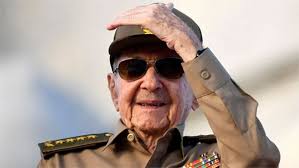
US Charges Raúl Castro Over 1996 Plane Shootdown