
Business
Over 207,976kg of drugs seized at seaports in 13months – NDLEA


The National Drug Law Enforcement Agency (NDLEA) has successfully intercepted and seized a substantial 207,976 kilograms of hard drugs at various seaports across the country between January 2023 and March 2024. This significant achievement was disclosed by the NDLEA’s Director of Media and Advocacy, Mr. Femi Babafemi, in a document shared with The PUNCH on Sunday.
Detailing the seizures, Babafemi revealed that in the first quarter of 2024 alone, 14 suspects were apprehended with 16.69kg of cocaine and 11,622.229kg of cannabis sativa.
Additionally, from January to October 2023, 167 individuals were arrested with a total of 196,336.99kg of various drugs. Regarding the financial value of the confiscated drugs, Babafemi emphasized the agency’s policy of not assigning a monetary value to the seizures to avoid inadvertently glorifying or encouraging drug trafficking activities.
“We do not put a value on the seizure to avoid glorifying criminal activities or motivating others into desperation,” he explained. Dr. Muda Yusuf, the Chief Executive Officer of the Centre for the Promotion of Private Enterprises, reacted to these developments by advocating for stricter sanctions on offenders.
He noted the increasing desperation among individuals seeking to profit from the drug trade and suggested that harsher penalties could serve as a deterrent. “People are becoming more desperate to make money from these hard drugs.
If the government introduces more deterrent sanctions, perhaps they won’t be that daring or desperate to make quick money and dare to face the risk of committing such crimes,” he stated. Dr. Yusuf believes that stronger sanctions could send a clear message globally that drug trafficking is a severe crime with significant consequences.


Dozens of supermarkets across seven European countries have been affected by a cyber-attack targeting refrigeration systems, raising concerns over food safety and security.
Around 40 Delhaize supermarkets in Belgium and Luxembourg were impacted, alongside a smaller number of stores in Sweden, Ireland, the Netherlands, Estonia and Finland.
Belgian refrigeration manufacturer Sabcobel said the affected units had their evaporators switched into defrost mode, causing temperatures to rise. The method is believed to be similar to an attack last month that disrupted hundreds of French supermarkets.
Millions of euros worth of food reportedly had to be discarded following the October incident in France.
Sabcobel chief executive Stephan Moelans told Belgian news agency Belga on Monday that the latest incident was a cyber-attack and that the company had worked overnight to disconnect affected refrigeration units from its network.
He said the company had been working to protect customers’ refrigerators against the vulnerability since the French attack, but warned that physical modifications were required rather than software updates alone.
Most supermarkets across Europe connect their refrigeration systems to the internet, allowing maintenance and troubleshooting to be carried out remotely.
“The simplest solution is to manage the fridges over a secure internet connection. Most of our customers switched to that after the attack in France,” Moelans said.
Reports indicated that temperatures in refrigeration units at several affected stores across Europe had climbed as high as 50C (122F).
Authorities have yet to identify those responsible for the latest attack.
Meanwhile, US authorities are investigating refrigeration malfunctions reported at several American military bases in August, working alongside French officials to determine whether the incidents could be connected.
Belgium and Sweden’s national cybersecurity agencies confirmed they were monitoring the situation.
The UK’s National Cyber Security Centre said it was working with international partners and industry representatives to establish the full details of the incident.
No cyber-attacks involving supermarket refrigeration systems have been reported in the UK.

Binance, the world’s largest cryptocurrency exchange, says it has covered 90% of the $6.3bn (£4.7bn) worth of assets stolen in a major cyberattack on Thursday.
The company said the remaining 10% could take longer to recover or replace because of difficulties sourcing the required amounts.
Binance has repeatedly promised to cover all losses resulting from what is suspected to be one of the largest cryptocurrency hacks on record. The exchange said it had set aside more than $6.34bn in company funds to compensate affected users.
In a statement released on Saturday, Binance assured customers that they would not bear the financial consequences of the attack.
“Binance will absorb the financial impact of these stolen funds, not our users,” the company said.
On Sunday, the exchange announced that withdrawals had been restored across several of its networks after being suspended following the breach. It had earlier indicated that withdrawals would resume gradually in phases.
The Federal Bureau of Investigation (FBI) said on Saturday that North Korea was responsible for the cyberattack.
According to the agency, hackers had begun converting the stolen assets into Ethereum, with further transfers expected through decentralised finance platforms and instant cryptocurrency swap services.
However, US President Donald Trump said the government was still investigating the identity of those responsible.
Speaking to reporters on Saturday night, Trump said: “We’re learning about it. We don’t know if it’s North Korea – but if it is, we’ll talk to North Korea about it.”
Binance said it had replenished the stolen funds through a combination of available resources and its corporate treasury.
The exchange added that affected holdings of Bitcoin, Ethereum and Tether, alongside seven other widely traded cryptocurrencies, would be covered under its compensation arrangement.
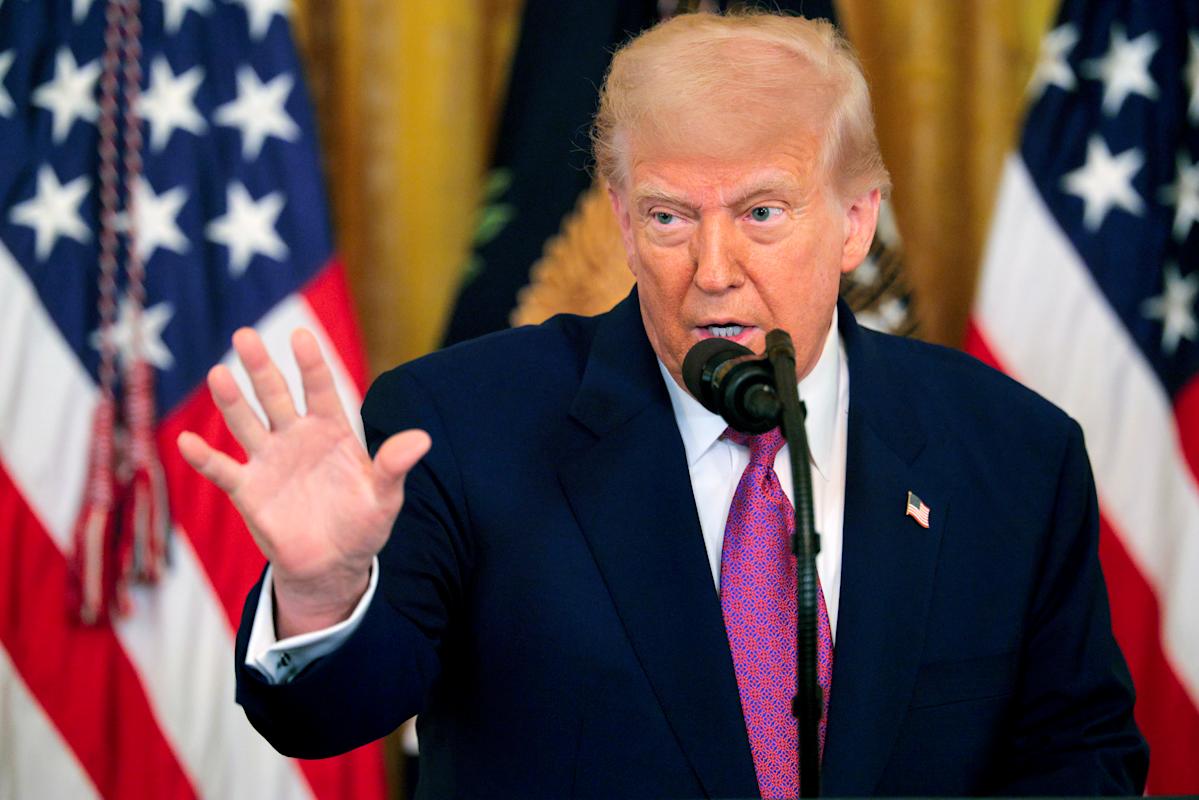
US President Donald Trump has appointed the director of national intelligence to lead a new taskforce focused on artificial intelligence.
Jay Clayton will head the taskforce, which Mr Trump said would coordinate the federal government’s engagement with consumers, companies, public interest groups and “religious organizations”.
The move has drawn criticism from Democrats, including Senator Elizabeth Warren, who has called for stronger regulation of AI.
Mr Trump has opposed laws that could restrict the development of the technology, despite growing debate over the potential risks of AI and its implications for society.
Last week, the president and leaders of major AI companies signed a “morally binding” agreement making the companies responsible for ensuring the safety of their own technology.
Mr Trump, who has sought to promote the term “super intelligence” for AI, wrote on social media that the new “Super Intelligence Force” would coordinate the federal government’s engagement with “Consumers, Public Interest Groups, Religious Organizations, Critical Infrastructure Providers, and Super Intelligence Companies”.
Mr Clayton, a former chair of the Securities and Exchange Commission, will be joined on the taskforce by Andrew Ferguson, head of the Federal Trade Commission, and Emil Michael, undersecretary of defence for research and engineering.
The taskforce will report directly to Mr Trump and White House Chief of Staff Susie Wiles.
Mr Trump has repeatedly rejected calls for a slowdown in AI development, saying the US is leading China in the technology race.
“And, frankly, I want to keep it that way because whoever wins AI, wins,” he said.
President Xi Jinping recently travelled to Washington for a state visit. Days later, Mr Trump ruled out a joint venture between the US and China to develop AI.
“If we do that, we’re going to be giving a lot of secrets that we have that they [China] would want to have, or anybody else,” he said.
The announcement comes amid growing pressure from prominent figures in the technology industry, including executives at OpenAI and Anthropic, for tighter regulation of AI.
Mr Trump first announced the taskforce in September, prompting Senator Warren to criticise the plan.
“Congress cannot meet the pressing threat of AI by just forming another committee or continuing to have drawn-out discussions about it,” she said.
“Let’s actually pass some meaningful regulations on AI to protect people.”


Meghan Markle’s Father Thomas Markle Arrested Over Alleged Child Abuse Material

Jobe Bellingham Joins Brother Jude in England Squad After Impressive Rise

Newcastle’s Dedic questioned by police after being spotted with bow and arrows


-

 News1 week ago
20-Year-Old Copilot Among Nine Killed in Florida Jet Crash
-

 Business1 week ago
Cyber-Attack Targets Supermarket Freezers Across Seven European Countries
-

 Sports6 days ago
Cristiano Ronaldo announces retirement from Portugal national team
-

 News7 days ago
JD Vance Blames Iran War for Republicans’ Crushing Midterm Election Defeat
-

 Sports1 week ago
Fifa Agrees to Share Confidential Documents Amid Uefa Pressure Over Controversial Sell-Off Plan
-
 Sports5 days ago
Jobe Bellingham Joins Brother Jude in England Squad After Impressive Rise
-

 Business1 week ago
Binance Covers 90% of $6.3bn Losses Following Major Cryptocurrency Hack
-

 News1 week ago
Spain’s Transport Minister Resigns Following Deadly Train Collision