
News
Hurricane Oscar Claims Six Lives in Cuba

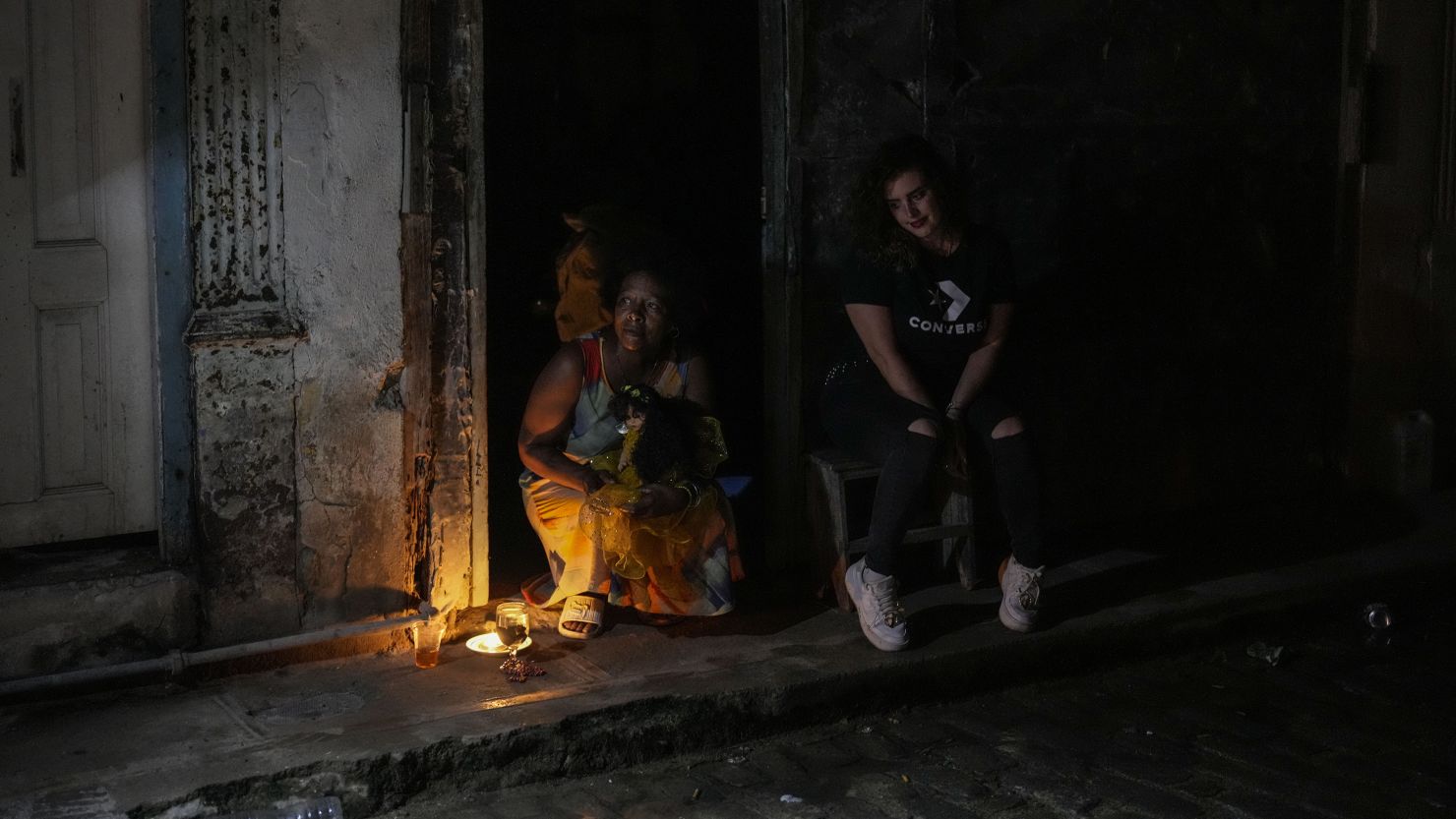
Hurricane Oscar has tragically claimed the lives of at least six individuals in Cuba, as confirmed by the nation’s president, Miguel Díaz-Canel. The storm made landfall as a Category 1 hurricane near Baracoa in eastern Cuba on Sunday afternoon, later weakening to a tropical storm as it moved across the island.
The province of Guantánamo suffered the most significant damage, with over 1,000 homes impacted by the severe rains and strong winds that accompanied the hurricane. Notably, Oscar hit during a nationwide power outage that left approximately 10 million Cubans without electricity.
As of early Tuesday, President Díaz-Canel reported that certain areas remained inaccessible due to the storm’s aftermath. He emphasized that rescue workers were diligently working to reach those stranded. The president highlighted that the municipalities of San Antonio and Imías experienced extraordinary levels of flooding, marking historical records for the regions.
The six confirmed fatalities were all reported in San Antonio, although no further details regarding the circumstances of their deaths have been released. Meteorologists have issued warnings that Oscar may cause localized flash flooding in the southeastern Bahamas and the Turks and Caicos Islands as it continues its northeastward trajectory.
In the wake of the storm, some residents in areas still without power expressed their frustrations through rare public dissent, chanting “Turn on the lights” and banging pots and pans in protest. While power outages are not uncommon in Cuba, the recent failure of the country’s largest power plant has exacerbated the situation, leading to widespread darkness across the nation.
President Díaz-Canel attributed the current crisis to the tightening of the decades-long U.S. trade embargo, stating that the Cuban state would persist until power is fully restored. However, frustrations are mounting among residents in neighborhoods still experiencing outages, with many expressing their discontent with the situation.





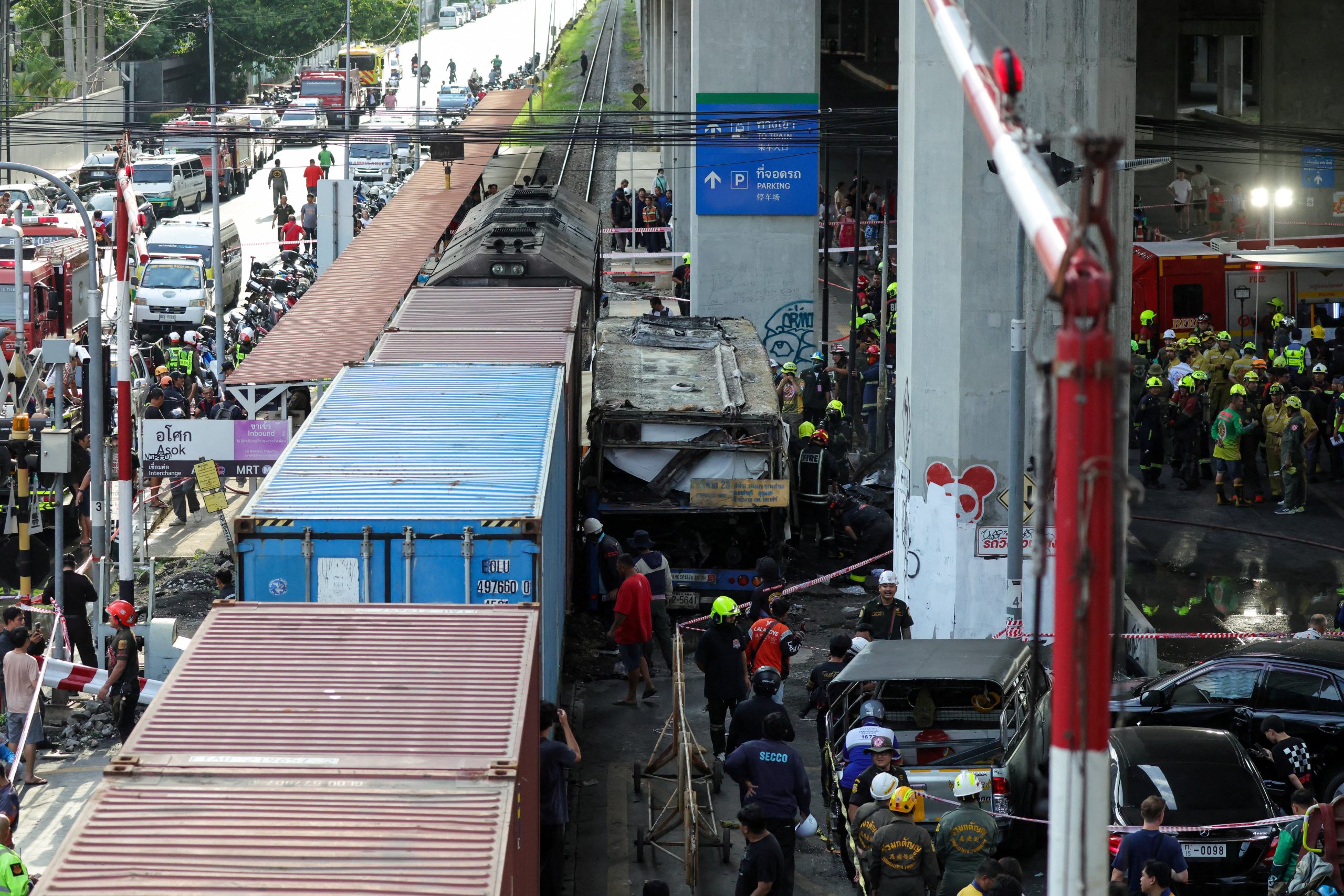
The driver of a freight train involved in a deadly collision with a public bus in Bangkok has tested positive for drugs and now faces charges of reckless driving, Thai police have confirmed.
The crash occurred on Saturday afternoon at the busy Asoke-Din Daeng railway crossing when the freight train slammed into a public bus that had reportedly become stranded on the tracks.
The impact caused the bus to burst into flames, killing eight people and leaving dozens injured.
Initial investigations suggest heavy traffic prevented the bus from clearing the crossing in time. Authorities also believe the congestion stopped the manually operated railway barriers from closing properly before the train approached.
The Asoke-Din Daeng crossing is known as one of the busiest and most congested traffic points in Bangkok.
Police said both the bus driver and the railway guard responsible for lowering the barriers have also been charged in connection with the incident.
Pichet Kunadhamraks, director-general of Thailand’s rail transport department, announced that mandatory drug and alcohol testing would now be required for all train drivers and railway personnel before starting work shifts.
Authorities have not disclosed which substances were detected in the train driver’s urine test.
According to preliminary findings from the train’s black box, the emergency braking system was activated only about 100 metres (330 feet) before impact — a distance investigators say was too short to prevent the collision.
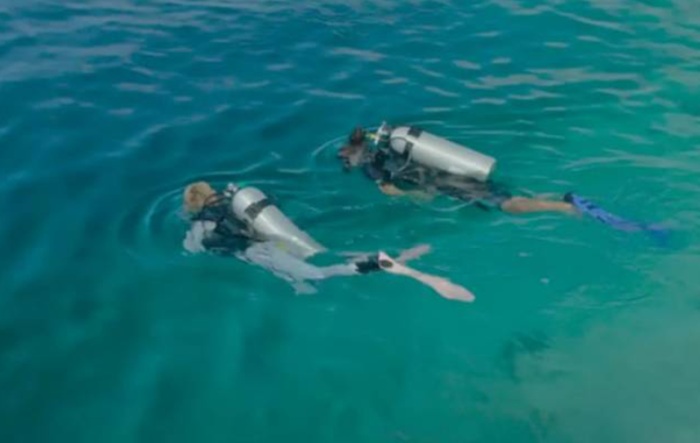
The bodies of four Italian divers who disappeared during a scuba diving accident in the Maldives have been recovered, local authorities confirmed.
One member of the group had already been found shortly after the incident, which took place last Thursday.
Officials said the four remaining victims were discovered inside a cave around 60 metres (197 feet) underwater in Vaavu Atoll during a joint recovery operation involving specially trained Finnish and Maldivian divers.
The tragedy also claimed the life of a Maldivian rescue diver who died on Saturday while taking part in the search effort.
Authorities believe the accident is the deadliest single diving incident recorded in the Maldives, a country internationally known for its tourism industry and coral island resorts.
Four of the Italian victims were linked to the University of Genoa research team. They were identified as Prof Monica Montefalcone, her daughter Giorgia Sommacal, and researchers Muriel Oddenino and Federico Gualtieri.
The fifth Italian victim was diving instructor and boat operations manager Gianluca Benedetti.
The Maldivian rescue diver who died during the operation was identified as Staff Sgt Mohamed Mahdhee.
Officials believe all four bodies recovered this week were located in the same underwater cave where military personnel had earlier discovered the first victim on the day of the accident.
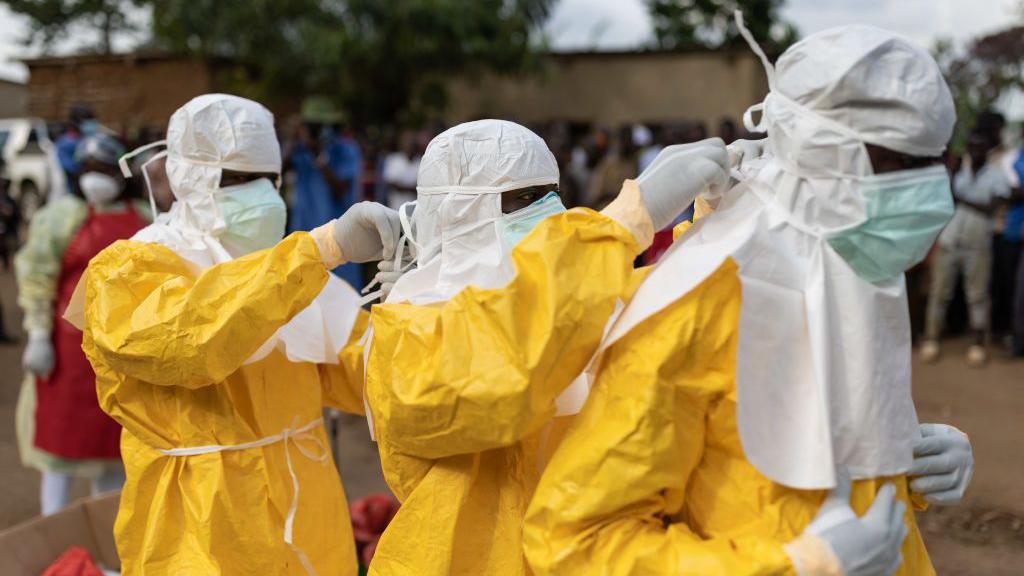
At least six Americans were exposed to the Ebola virus during the ongoing outbreak in the Democratic Republic of the Congo.
The outbreak has already prompted the World Health Organization to declare an international health emergency, with authorities in DR Congo reporting about 350 suspected cases and 91 deaths.
One American is believed to be showing symptoms linked to the virus, while three others reportedly experienced high-risk exposure. It remains unclear whether any of the individuals have tested positive for Ebola.
The Centers for Disease Control and Prevention confirmed it was assisting with the “safe withdrawal of a small number of Americans who are directly affected,” though officials declined to specify the number involved.
Health officials say the outbreak is caused by the Bundibugyo strain of Ebola, for which there are currently no approved vaccines or treatments.
There have also been two confirmed Ebola cases and one death reported in Uganda, according to the CDC.
Reports indicate the US government is working to move the affected Americans from DR Congo to a secure quarantine location. Health news outlet STAT reported that the group could potentially be transported to a US military base in Germany, although this has not been officially confirmed.
During a press briefing, CDC officials declined to answer direct questions regarding the Americans reportedly exposed, but maintained that the overall risk to the United States remains low.
The US has meanwhile issued a Level Four travel advisory — its highest warning level — advising citizens not to travel to the DR Congo.
The WHO warned that the outbreak in Ituri province could become significantly larger than currently detected, with concerns over local and regional spread. However, the agency stated the situation does not yet meet the criteria for a pandemic.
Ebola remains one of the world’s deadliest infectious diseases. During the 2014–2016 outbreak in West Africa, more than 28,600 people were infected and 11,325 died across countries including Guinea, Sierra Leone, the United States, the United Kingdom and Italy.
Jean Kaseya, director general of the Africa Centres for Disease Control and Prevention, urged communities to follow strict public health measures, especially guidelines surrounding the handling and burial of Ebola victims, as efforts continue to contain the outbreak.


Train Driver in Deadly Bangkok Crash Tested Positive for Drugs

Bodies of Missing Italian Divers Found in Maldives

Six Americans Exposed in DR Congo Ebola Outbreak


-
 News1 week ago
Frontier Airlines Plane Strikes and Kills Runway Trespasser During Take-Off at Denver Airport
-

 News1 week ago
Philippine Vice-President Sara Duterte Impeached Again
-
 News1 week ago
US and French Passengers Test Positive After Deadly Hantavirus Cruise Ship Outbreak
-

 Sports1 week ago
Liverpool Reveal Design for Permanent Diogo Jota and Andre Silva Memorial
-
 News6 days ago
Philippine Senate Locked Down After Gunshots Fired
-
 News3 days ago
Rescue Diver Dies During Search for Italian Divers Missing in Maldives Cave Tragedy
-

 Entertainment5 days ago
Madonna, Shakira and BTS to Headline Historic World Cup Final Half-Time Show
-

 Sports3 days ago
Celtic F.C. Stun Heart of Midlothian F.C. to Seal Dramatic Title Win