
News
EU Plans Social Media Restrictions for Children Under 15


The European Union has announced plans to restrict social media access for children under 15 in a move aimed at improving wellbeing and strengthening online safety.
Under the proposed rules, children under 13 would be banned from accessing social media platforms, while those aged 13 to 15 would be limited to one hour a day through “mini accounts” linked to a parent or guardian’s account.
The European Commission said social media companies would have to demonstrate that their platforms were safe by design.
EU Commission President Ursula von der Leyen said the proposals would “put parents back in the driving seat” and give families greater control over how children use social media.
She said the legislation, known as the EU Kids Act, would provide parents with “the tools to help their children navigate a safer world”.
“Too many children are being exposed too early to an online world they are not ready to navigate – an environment where bullying can follow you home, where every mistake can be recorded forever,” von der Leyen said.
Under the proposed legislation, only those aged 15 and over would be able to create their own social media accounts.
However, von der Leyen stressed that an age limit alone would not remove responsibility from technology companies for content available on their platforms.
“An age limit does not mean letting tech companies off the hook for the content on the platform,” she told the European Parliament on Thursday.
If approved, the legislation would require platforms to submit detailed child-safety plans and comply with a “safety by design” principle for users under 18.
“For every person under 18, the platforms must follow the principal of safety by design, no toxic or addictive features, no traps, etc,” von der Leyen said.
The proposal would use the EU’s existing age-verification app to determine users’ ages.
Von der Leyen had previously called for a “delay” in children’s access to social media, saying in May that discussions over a minimum age could no longer be ignored.
The policy was formally outlined on Thursday after being previewed in her annual State of the Union address the previous day.
Several EU countries have already announced their own measures to restrict children’s access to social media, including France and Spain.
An EU-wide law would supersede those national measures, although individual member states could introduce stricter rules.
It remains unclear exactly which platforms would be covered by the proposed bloc-wide restrictions. Von der Leyen said the Commission had examined Australia’s approach when developing its plans.
Australia banned platforms including Instagram, Snapchat and TikTok for users under 16 in December last year.
Enforcement has proved challenging, with Australian Communications Minister Anika Wells saying earlier this month that no technology company had yet been fined, despite research indicating that many under-16s continued to use social media platforms.
The UK is also preparing a similar ban for under-16s, which is due to come into force next spring.


France has suspended the use of stun grenades during student protests after a 15-year-old boy lost his hand in an incident in the northern city of Lens.
Interior Minister Laurent Nuñez said he had ordered the suspension while authorities establish what happened during Monday’s incident, amid conflicting accounts from protesters and officials.
Several groups have accused police of using disproportionate force against teenagers taking part in demonstrations.
The protests continued on Wednesday, with more than 500 schools fully or partially closed. Prime Minister Sébastien Lecornu is expected to address the school protests in an evening speech.
Education Minister Édouard Geffray told France’s National Assembly that 24 schools had been “set alight or vandalised” so severely that they would remain closed for several weeks, affecting about 30,000 pupils.
Hundreds of thousands of people took part in demonstrations on Tuesday, calling for improved school conditions. Tear gas and water cannon were deployed in some cities, while the interior ministry said 488 people had been arrested and 43 security personnel injured.
Nuñez told French radio RTL that the police watchdog, IGPN, had opened 18 investigations into whether officers had used proportionate force during the demonstrations.
The protests have expanded beyond high school pupils to include parents, university students and trade unions.
“There is a police action that raises questions for all of us within the Ministry of the Interior; it’s what happened in Lens,” Nuñez said.
He confirmed that the use of stun grenades was being suspended “until the facts surrounding this case have been clarified”.
The teenager’s hand was torn off after an anti-encirclement grenade exploded near Auguste Béhal High School in Lens, near Lille.
Authorities said the boy picked up the grenade before it exploded, while students alleged that he was directly hit after an officer fired it.
According to the local prefect, police had been confronted by around 200 to 250 students who were throwing stones and fireworks.
The stun grenade is classified as a non-lethal weapon and releases small rubber pellets when it detonates.
“When there is suspicion of disproportionate force, there are always judicial investigations,” Nuñez said, adding that the government was “here to protect high school students”.

US death row inmate Christa Pike is conscious and speaking after surviving a failed execution attempt in Tennessee, her lawyers say.
Pike, 50, remains in hospital receiving critical medical care and is being kept “handcuffed and shackled to the bed”, according to a statement from her legal team.
An anaesthesiologist advising her lawyers said that Pike is able to communicate in a “basic way”, although she does not appear to remember the execution attempt.
Pike was sentenced to death for the 1995 murder of Colleen Slemmer, whom she killed with her then-boyfriend. She survived two attempts to administer a lethal injection on 30 September in Tennessee.
Her apparent recovery has been described by medical and legal experts as unprecedented.
Pike is believed to be the only person to survive after a lethal injection was successfully administered. The failed execution was described as a “mess” by Slemmer’s mother, who had supported Pike being put to death.
After it became clear that Pike would not die, she was taken to hospital, where she remained unconscious for several days while medical staff worked to remove the injected chemical from her body.
Her lawyers said on Tuesday that her prognosis remained uncertain and that they expected “at a minimum, a long recovery”.
An anaesthesiologist advising Pike’s legal team said the chances of recovering from a lethal injection were extremely low.
“Most people who get lethal injection die from it,” he said, adding that there were still significant unknowns, including how much pentobarbital entered Pike’s system.
“I would not, in any way, say at this point that all the big risks are behind her,” he said.
“They did everything they were supposed to do as part of the execution process, and it simply didn’t work,” she said. “This has never happened before.”
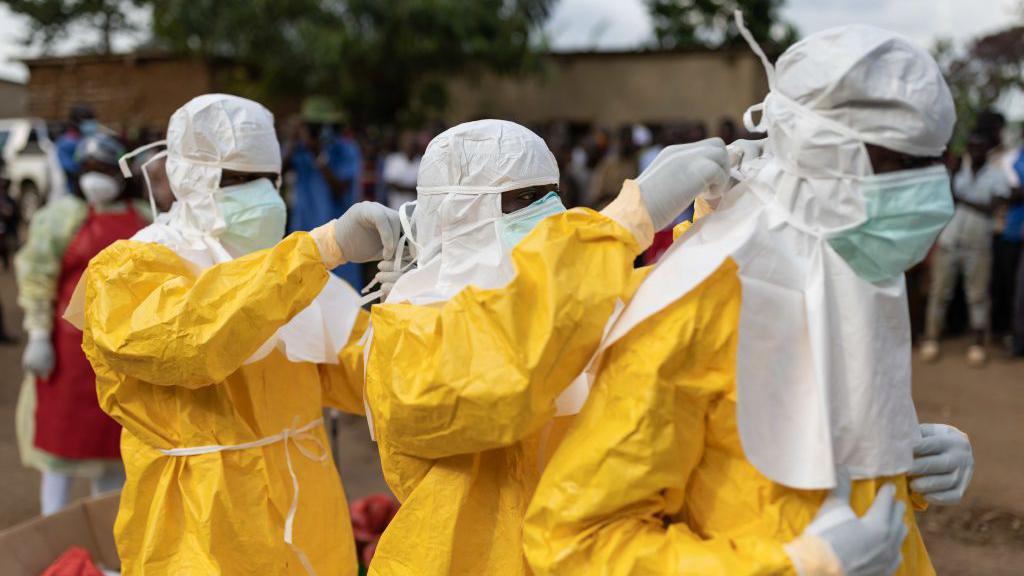
Kenya has confirmed its first Ebola case, involving a Kenyan citizen who had been living in the Democratic Republic of Congo (DRC) for the past seven years.
Health Minister Aden Duale said the patient, who had fallen ill about a month ago and received treatment at several hospitals in the DRC, died days after arriving in Nairobi.
Mr Duale said the patient travelled to Kenya by plane on Saturday and underwent routine public health screening at Nairobi’s main airport before being taken to a hospital in the city by a relative.
Tests later confirmed that the patient had Ebola caused by the Bundibugyo virus.
Authorities are monitoring the situation as concerns grow over the potential spread of the virus following the confirmed case.
More than 4,000 people have died from Ebola in the Democratic Republic of Congo this year, making the outbreak the second-deadliest known outbreak of the disease.


Mikel Arteta signs new contract with Premier League champions Arsenal

France suspends stun grenade use after teenager loses hand during protests

Christa Pike awake and speaking after failed execution, lawyers say


-

 Business1 week ago
US ban on Canadian alcohol and dairy imports comes into effect as trade tensions continue
-

 News1 week ago
RAF Fairford incident involved ‘foreign actor’, says Marco Rubio
-
News1 week ago
UK-Iranian man arrested in RAF Fairford terror investigation
-

 Entertainment1 week ago
Celine Dion surprises Paris Fashion Week with runway performance
-

 Entertainment1 week ago
Kanye West’s Russia concerts officially cancelled after weeks of uncertainty
-

 News4 days ago
US withdraws all bombers from RAF Fairford amid security concerns
-

 News1 week ago
Former world snooker champion Graeme Dott jailed for seven years for child sex abuse
-
 Business4 days ago
Trump appoints top intelligence official to lead new AI taskforce